A stop off at the gambling hall on the way to school
At 6:40am in Domnești, a small village in Central Romania, the smell of coffee and cigarettes and the sound of crumpled sports betting tickets start the day off for multiple high schoolers. Only a few hundred metres away from the high school, two gambling rooms have become a hangout spot for commuting students, arriving before the school opens at 7:10.
12.12.2025
de Raluca Cristea, Foto: Raul Ștef
Even though the owner of the establishment claims he does not allow underage patrons to play the slot machines, the students spend their mornings there smoking, drinking soda and coffee and sometimes even gambling. The principal of the high school admits the phenomenon is known and worrisome.
A bill adopted by Romania’s Senate on March 13th 2023 proposes banning bookmakers and gambling houses operating less than 300 metres walking distance from schools, kindergartens, playgrounds, cultural institutions or banks. However, the proposal has been blocked in the committees of the lower chamber of Romania’s parliament for over two years.
To understand the rules governing minors’ access to gambling rooms, two female employees describe contrasting realities. In large cities, entry is strictly controlled through automatic ID checks. In smaller towns, however, where there is no security, employees admit that minors often manage to get in. The stories of two young people reveal that first contact with gambling frequently occurs during the teenage years – often introduced by adults or peers. Nationwide, the exact number of gambling rooms is not publicly disclosed by the national gambling authority.
Morning routine
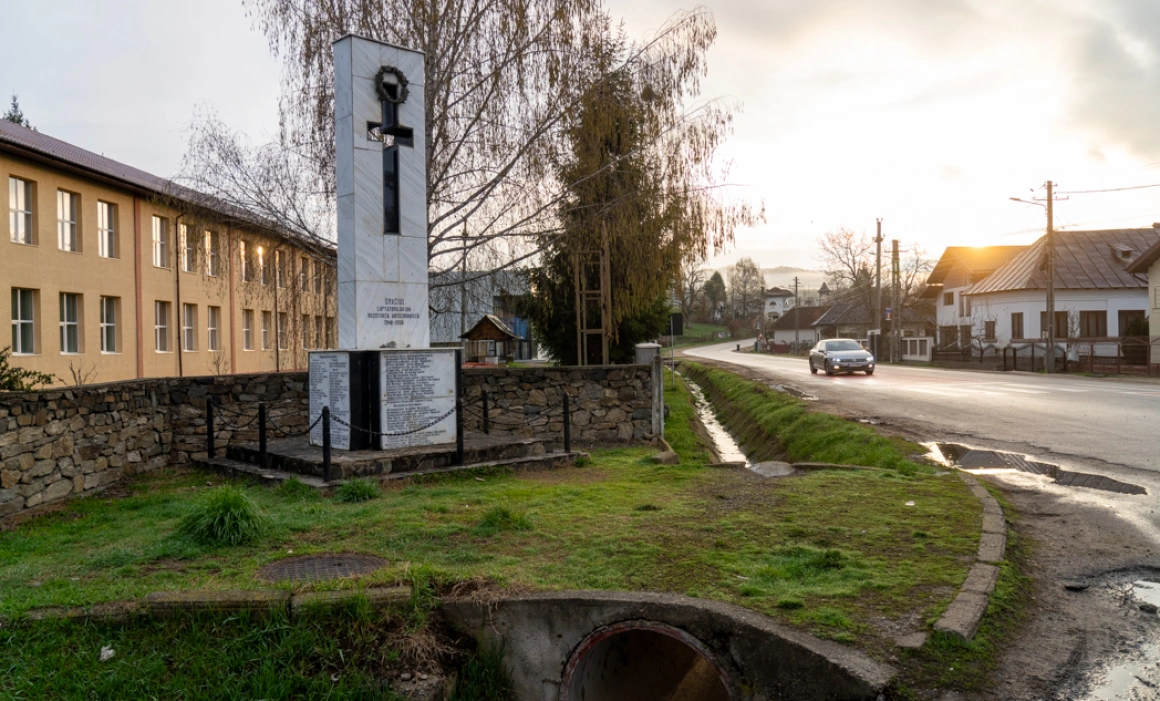
It is past six in the morning. We’re in Domneștiul de Argeș, a village with a population slightly over 3,000 according to the 2021 census. At the crossroads of Neagoe Basarab and Alexandru cel Bun streets, in an island of green surrounded by iron chains, lies a map of the village, Romanian and EU flags, a monument to heroes and two cannons facing east. Slowly, dawn breaks. At the end of March, a spring coat does not hold up to the cold. The ground glitters with frost.
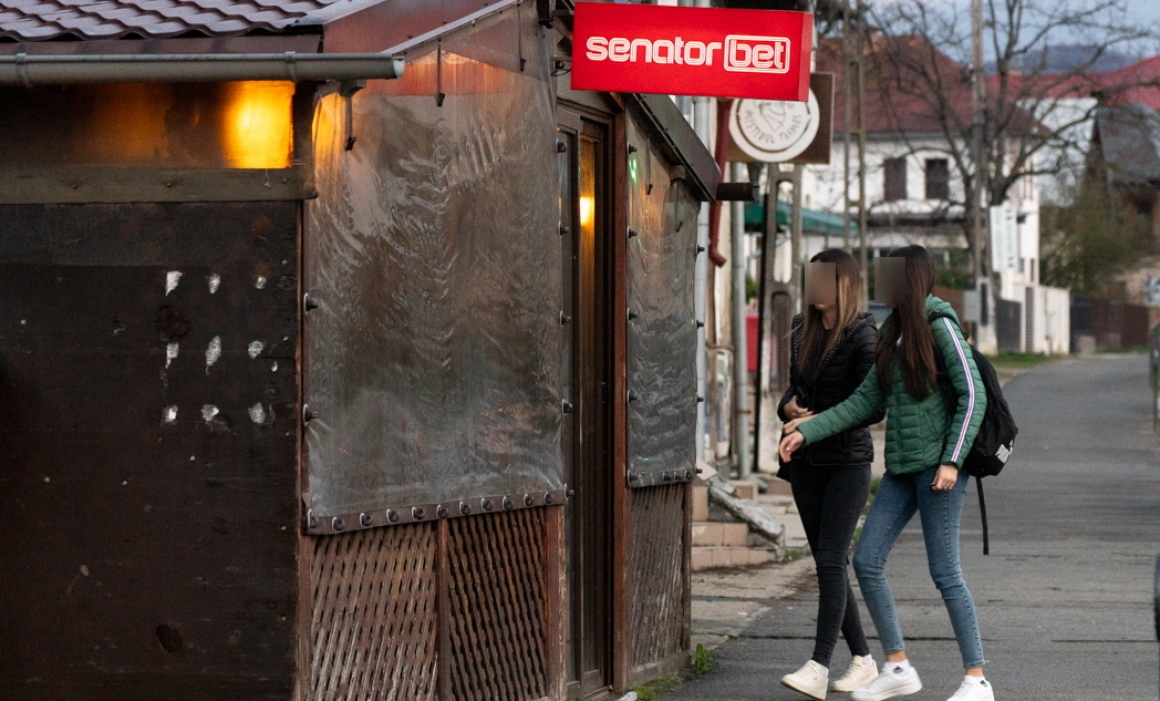
The first clients are beginning to show up at Senator Bet – a gambling house at the intersection. The building is a two-storey house, with a tidy facade and a tiled roof. The porch – wooden and covered in see-through tarp, presumably for smokers – opens up directly to the pavement.
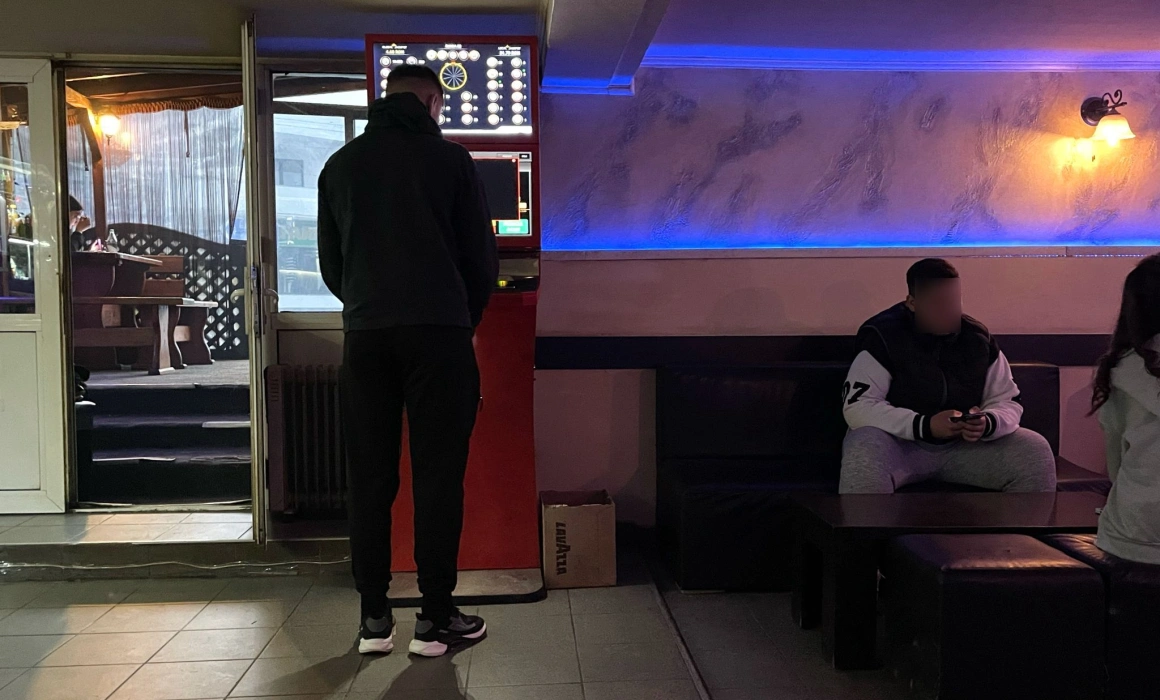
“One cappuccino, one raspberry Lipton and a pack of blue Dunhill,” a young man in a military vest, there with his girlfriend, orders at the bar. A coffee is five lei, while a soda is seven. He drops ten more lei at the live betting machine and goes out on the porch for a smoke. The gambling room is a low-ceilinged space. When you come in through the porch, you see the bar where you can pick from a wide variety of sodas, energy drinks, cigarettes and coffee. On each side of the door there is a slot machine. Next to the machines, a sign reads gambling is illegal for those under 18.
Large Lavazza cardboard boxes are overflowing with lost and crumpled betting tickets. Not counting the porch, the space has five small tables surrounded by stools. Blue LED lights complete the mood set by the four screens set up on the wall, some broadcasting the sport network, others winning games. Even the porch is heated by an electric machine. Here, too, the clients have two screens to follow the games and a slot machine to bet on them. Two female employees are working the shift, taking turns to go out for a smoke on the porch. Round 79 is coming up. In 24 seconds they will announce the Jackpot.
It is 6:40am, the crack of dawn. Two girls carrying backpacks on one shoulder walk into the gambling room. One stays on the porch to look out for their bags, and gives the other her money to get her a sparkling water and a cappuccino. They light up cigarettes. Eight other high schoolers walk in and spread out in the room, each doing their own thing. “I slept three hours,” one of them complains. Another goes straight to the bar. The employee of the gambling room asks him to tell her his personal numerical code (CNP), which is similar to a social security number.
“Do you think I don’t know it?” the high schooler asks in response.
“What if I asked for your ID right now, would you give it to me?” the employee retorts.
“I don’t have it on me,” the boy responds. He has three betting tickets on the table. A female classmate just sat down next to him. They seem close.
“Just a warm-up, because on Saturday I placed all the money I got.”
“Which money?”
“The money I got from the slot machines.”
He bet in the game “lucky six” – a game in which multiple numbered lottery balls are drawn from a board organized in rows and columns. He follows them on the screen on the wall, and, as they are being announced, he crosses off the numbers with his lighter off the ticket. It is 6:55.
Quiet arrangement
In the opposite corner of the room, another high school girl reads the drawn numbers to a bunch of boys: “12, 6, 4, 13, 23, 29, 48, 7”.
“I don’t like to hang out here, let’s go outside,” says a voice in the back of the room, from a group of three girls. And they head out on the porch, only after they check behind them not to forget anything. That is how every morning goes here.
On the way out of the betting house, I run into another student. “Honestly, I don’t have any opinion, I don’t really get involved in that,” he says when I ask what he thinks of the gambling room as a hangout spot. He sends me over to the high school – “maybe you’ll find kids there more eager to talk.”
There is about 500 metres between the gambling room and the Technological High School. Classes start at 7:30. In front of the high school, cars and buses shuttle students, one by one. Many of the students are commuters. Daniel, 18, gets to school at 7:20am by his personal car. He says that amongst the students, Senator Bet is known as a casino. Up until April last year, the place had slot machines too. But then the law that prohibits slot machines in towns with a population below 15,000 was passed. Since then, they removed the slot machines, resulting in many “starting playing a lot more online”. He says he was “never into it”, but he has classmates who bet 50 to 100 lei (around ten to 20 euros) each time. The teachers, he says, know about the students’ habits, but “it’s like a quiet thing, this arrangement”.
There were times when the police showed up to the gambling room. “It never went well,” he recalls. The principal, he says, “said we desperately need to come up with a solution for this”.
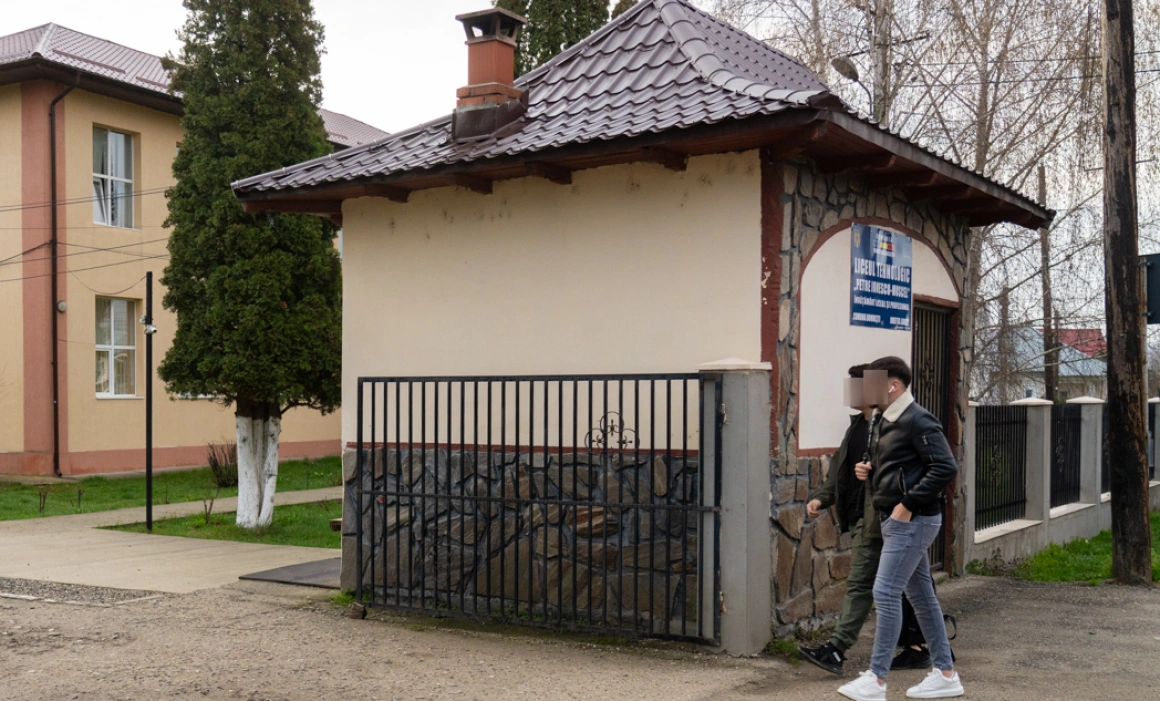
Because the town hall does not organize a school shuttle bus system that would adapt to the timetable of the high school, many students get to school half an hour early by private shuttles. George commutes from a nearby village and arrives in Domnești at 6:30am. Since the school only opens at 7:10, he spends his time at the gambling room.
“We go there early in the morning, since it’s open 24-hours,” he says. “I don’t do much. I just drink coffee. Or I take a nap. But I have friends who gamble on lottery balls, on roulettes. We don’t have any other place to go that’s warm and comfortable,” says the seventeen-year-old. He played too, but he says “he was unimpressed”. He has friends that play regularly – some put in one lei, hoping they’ll win back three, others put in “300, 400, even 1000 lei”.
“It begins here, in school”
Ovidiu Nicuț has been the high school principal here since 2016. He claims he tried to reduce the phenomenon of students starting their mornings in the gambling room near the high school.
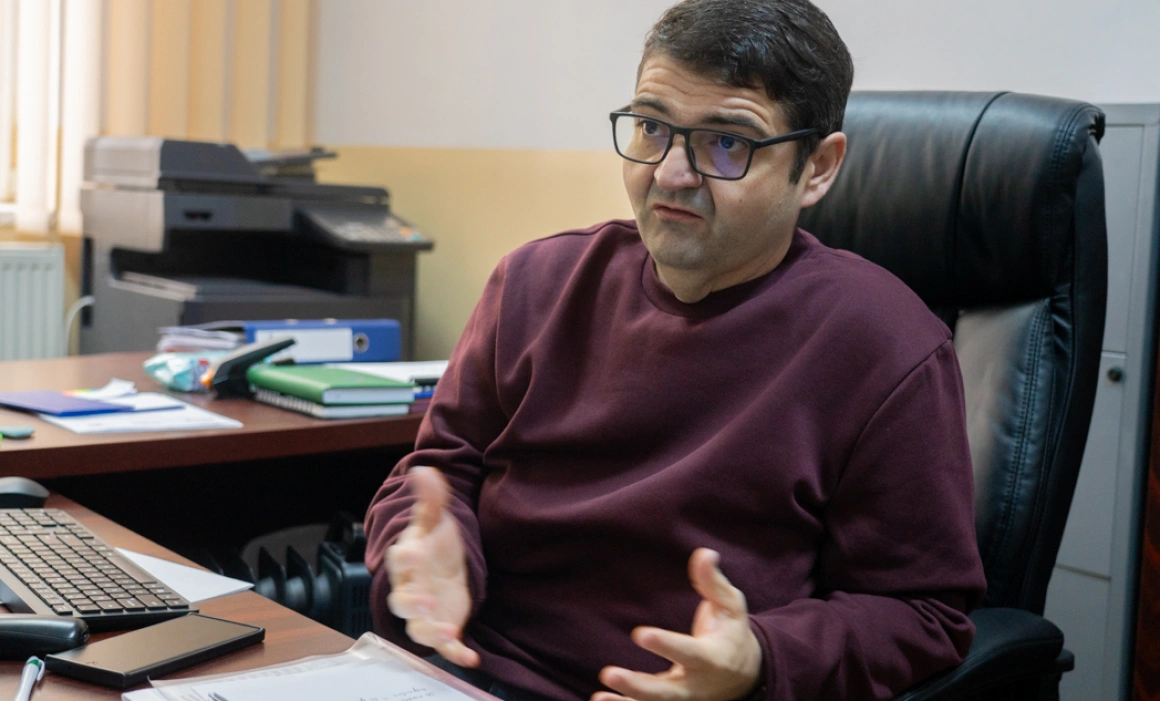
“It’s true that a part of the students that are absent from the first lesson go there as well. It’s not few. But we can’t say 450 are missing out of 750,” he explains. “It begins right here, in school,” says the principal, referring to the fact that often times students encourage one another to play. In total, the institution has approximately 750 enrolled students, out of which almost 450 are in high school.
Officially, classes start at 7:30, after a decision made through the administration council, meant to allow students to catch the shuttles taking them back home. Otherwise, they would be stuck in the village until around 5pm. Buses or private shuttles, like the ones coming from nearby Pitesti, do not fit perfectly with the high school timetable. Thus, students who arrive early often head to nearby spots: a small grocery market, a kiosk in front of the school, and two gambling rooms.
“We notified the police station in Domnești. In a specific case, they communicated they found nine students in the bar at 7:30am. We informed their parents and marked their absences in the electronic attendance sheet. But we can’t apply any direct sanctions, the rulebook only allows sanctioning acts that occur on school grounds,” the principal says to me. He admits the impact is negative. The high school confirmed officially, in a written response, that students of the school have been found in the gambling rooms “Total Bet” and “Senator Bet” during class hours. The principal claims they sent notices to the city administrators in towns from which the students commute. Social workers visited some of the families to talk to parents. “We have students with 150 to 200 unexcused absences,” he adds, “with around 25 severe cases. All of these were reported to local authorities”.
The school says they asked for official support from the rural Domnești police and requested action to identify students frequenting bars or pubs during school hours. The high school requested that for every case, the police should communicate the name of the student, as well as the date and time they were found. Local police sent the school an official note in November last year, in which they mention identifying nine students in a pub. The school says the only thing that could be done in this case was taking points off the conduct grade of the students for unexcused absences.
Between September 2024 and May 2025, the school organized 18 informational and counselling sessions about gambling for students. Of those, 11 were organized in collaboration with the community police, and the rest were planned by teaching staff, during homeroom and extracurricular sessions where partnering institutions were present. “The school alone cannot compensate for the lack of support and supervision of the family,” explained the principal.
Who is to blame?
According to Romanian law, which regulates the organization and operation of gambling in the country, only persons over 18 years old are allowed to participate in gambling. Minors are not even allowed to enter gambling rooms regardless of whether they play or not. Since October 2023, when Emergency Ordinance No. 82 was adopted, gambling rooms are prohibited in towns with a population of fewer than 15,000 inhabitants.
In Romania, gambling is divided into slot halls, betting agencies, lottery agencies, poker clubs, bingo halls, and casinos – both online and street-based. Gheorghe Gabriel Gheorghe, president of the national office for gambling, stated in an interview last year that Romania had 309 gambling organizers and 442 licenced second-class economic operators (intended for providers of related services in the gambling industry), a number that decreased compared to the previous year due to legislative regulations. The number of slot machines decreased from 86,000 at the beginning of 2024 to 52,000 by the end of the year. Last year, the total amount collected from taxes on gambling for the state budget was approximately 865 million euros, an increase of about five per cent when compared to previous years, according to Bursa.ro.
Constantin Ilie-Racoviță is the administrator of the two gambling rooms in Domneștiul. He claims that the establishments do not allow students to access the machines, in accordance with the law, but the two spaces are a few steps away from a high school and often attract teenagers.
“I’m not campaigning for them to gamble. But what should I do, not let them in? We’re not letting them play, I don’t need the two lei, five lei they have”, Racoviță argues. He admits that, unlike the Total Bet location he owns where the gambling room is separated from the bar, in the rented space of Senator Bet there is no clear delimitation between the gambling machines and the area where students can have their coffee. He deflects blame, saying that the employees are often “lazy, careless”, that “they don’t really care,” but says he sees a much larger danger in gambling games youth can access online.
The Romanian police claim they do not own or manage data regarding check-ups on minors' access to gambling halls. Meanwhile, representatives of the institution stated that according to the legislation in force, the responsibility for monitoring and sanctioning irregularities in this area lies exclusively with the national office for gambling.
The Argeș county police inspectorate admits to a lack of sanctions, explaining that, up to this point, it has not found “any criminal acts involving students from Domnești village, so no sanctions have been applied to either the students or the administrators of the respective locations", even though students, according to the legislation in force, are not allowed to enter the gaming halls. Moreover, “the police officers identified several students who were absent from classes, and the management of the school was informed in this regard. No sanctions were applied, and the situation was managed through preventive measures and institutional collaboration," the local police reported.
A few of the parents of the students asked the owner to prohibit minors from entering. “I would later receive calls from the parents asking me to let their children in, saying they're with a friend, a girlfriend, or a boyfriend, and just want to stay for a soda,” explains Racoviță, the owner of the gambling establishments.
Stricter ID checks in bigger cities
To understand how employees are trained regarding minor access to gambling rooms, we spoke with an employee at a room in Ploiești, a larger room, and a former employee of a small town location. In the Ploiești casino, identity verification is performed formally through an internal app which automatically flags whether a client is underage or has registered for self-exclusion – a voluntary ban on gambling.
“No one enters without verification. Minors have no place in our gambling room," shares the employee, who has two years of experience in the field. Upon hiring, staff receive clear instructions regarding the prohibition of minor access. "You receive all the necessary information and there are strict rules you cannot bypass.”
In smaller towns and rural areas, without security at the entrance, the reality is often different. One employee who worked three years in a gaming hall in a small urban area states that she initially followed the rule strictly, but found it difficult to maintain. “My colleague on the other shift frequently let in minors or drunk individuals. It was hard to control the situation when they showed up in groups, they had an attitude and ignored warnings. Since I was alone during my shift, I avoided conflict and tried to handle things peacefully.”
We spoke with two young men, aged 24 and 25, who played for the first time when they were teenagers. Mihai recalls that he used to go with his father to sport betting establishments during primary school. In the first year of middle school, he placed his first bet on football games with his childhood friends, and at 16, he played slot machines for the first time. He started with two to five lei per day, with neighbours from his block. Eventually, he started putting in 200 to 250 lei in a single evening.
“Some nights you could really feel out of control. When you're gambling on your phone, putting your card details in, everyone can lose themselves. And yes, a few times I felt like I was heading in a bad direction, but I didn't fall into the same trap as some of my friends," the 24-year-old shares. His friends lost money but “did not end up on the streets”. He remembers a case of a friend who "lost control completely". “He asks for 50 lei to gamble, then bets 100,000 and loses everything in the same night."
Addiction
The obsession sometimes starts with the first big win. That was also the case with Răzvan, now 25. He was 17 when he first won. He placed a ten-lei bet and won "around 3,500". "That's when the obsession with this sport started,” he says. Around the age of 17, he also started playing slot machines. His ID was not always required. Some people knew him, and it often depended on which employee was on shift. When he was in high school, he lost up to 1,000 lei in one evening.
"Especially after winning, I went almost every day. I was there for at least two to three hours after school. Sometimes I would leave at 11pm, even though school ended at 1pm." He sought advice from family and friends, but all he got was “don’t go anymore,” or “don’t bet anymore.”
“It’s hard when you get caught up winning, and you want more and more and more,” he admits. “But you end up with nothing. Losing control means losing money. A lot of money. When you want more, you bet more, and you don't win anything. Then you start thinking you won’t go back for a while, but after two or three days, you find yourself right back there," Răzvan says. Now he tries to limit himself to "a maximum of ten lei every two or three days" because "he almost always ends up losing”. Since reducing his spending, he has noticed that “it’s actually a good thing,” but he still has friends around him who “sometimes, less often, win; sometimes, more often, they lose”.
Translated by Simina Popescu.
This article was published in Romanian on Școala9 and produced within the Ratiu Forum Journalism Mentorship Programme, under the guidance of Adam Reichardt, editor-in-chief of New Eastern Europe. It was recently published both on the New Eastern Europe website and in its latest Issue 6 2025: Remembering yesterday, today.